guide
Placement test guide
10 min read
guide
Before you buy a book or book a course, one question is worth answering: What is your current level actually? Many people overestimate or underestimate their estimation. The placement test provides an objective answer in a short time.
The test is neither an admission exam nor an official certificate. It is a compass. It directs you to relevant content and saves your teacher weeks of guesswork.
Most free placement tests cover four areas:
Grammar: Tenses, structures, basic grammatical devices
Vocabulary: Words of everyday use and common situations
Reading comprehension: Short texts with comprehension questions
Production: Sometimes writing a sentence or choosing the most appropriate structure
The score is often presented according to the European CEFR framework: from A1 for complete beginners to C1 for advanced. This framework is known worldwide and facilitates communication with teachers and courses.
A well-guided test takes between ten and twenty minutes. If you find a test that promises you one minute, expect less accuracy. A good measurement requires a sufficient sample of questions.
Allocate quiet time without interruptions. No need to study in advance. The test measures what you know now, not what you can memorize tonight.
The only useful preparation is good sleep and concentration. Do not use a dictionary during the test. A distorted result will do you more harm than good: you will get content that is too difficult or too easy.
If you are not sure of an answer, guess logically. Many tests do not deduct for wrong answers. An intelligent guess sometimes reveals hidden knowledge you didn't realize.
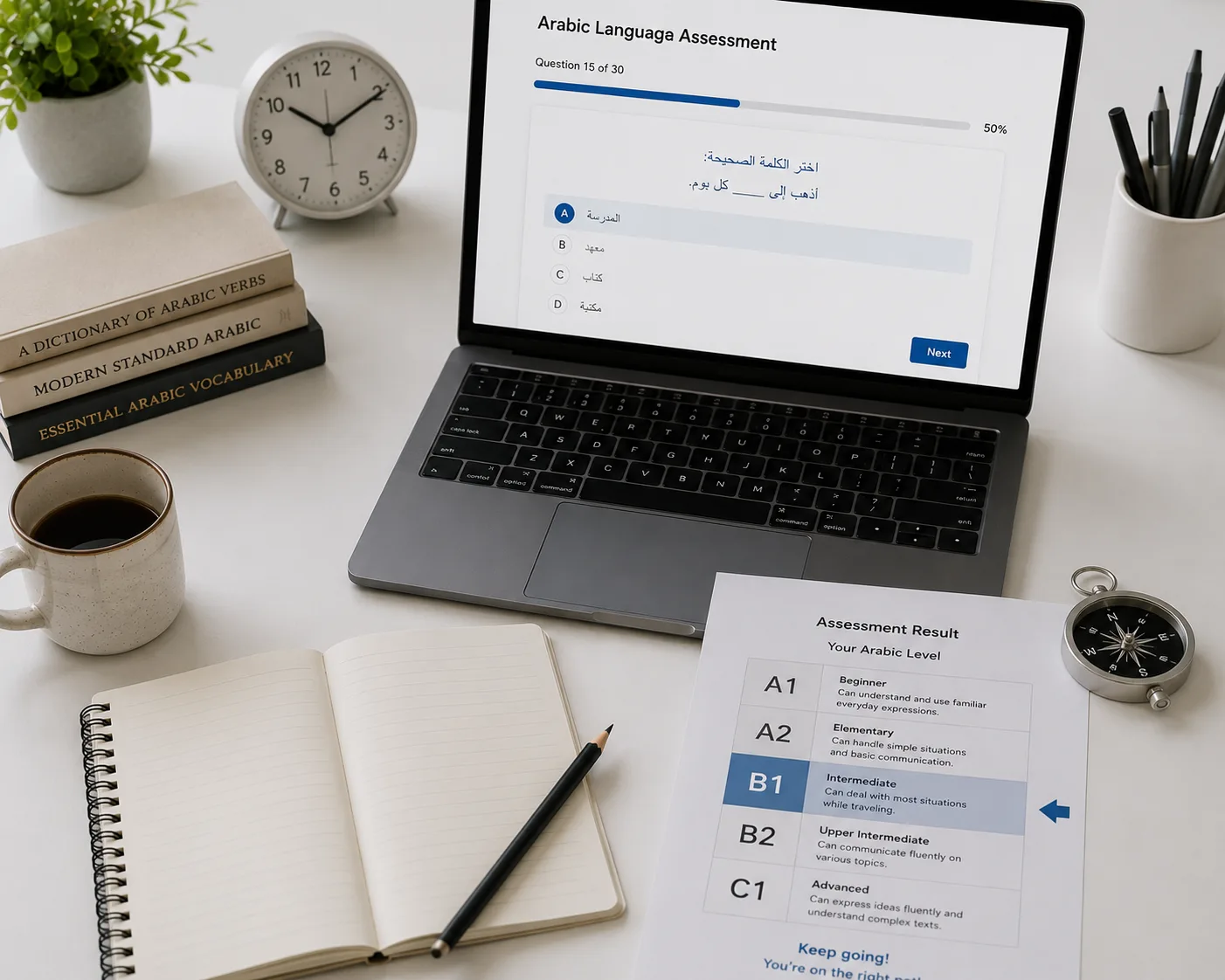
A1 level means you're building a foundation: greetings, numbers, simple sentences. B1 means that you deal with everyday situations and see the structure of the language more clearly. B2 means fluency in a variety of contexts with some gaps.
Don't be discouraged if the result is less than you expected. Knowing your true starting point is the quickest path to improvement. The opposite is also true: a higher score means you are ready for a tougher challenge.
Save your score in your file if you create an account.
Choose content that matches your level or just one level higher
Book a trial lesson so the teacher can discuss a personal plan.
Retake the test after three months to measure Progress
Start your free test now. After the result, Book a private lesson or Browse the courses appropriate to your level.
Do I need an account? You can take the test without Calculation, but registration saves your result and makes it easier for the teacher to view it.
Is the result final? No. The level changes with learning. The test is a snapshot at a specific moment.
What if you feel the result is inaccurate? Discuss it with a tutor in a test session. Human evaluation complements automated testing.
Result alone is not enough. Converting it into a plan requires a goal and weekly time. Example: A2 score, simple conversation goal within three months, three hours per week. The tutor helps you turn this equation into a practical schedule.
Those who start without a test often repurchase resources or reserve the wrong level. Ten minutes now saves money and time later.
Test your level, then get moving. The test is free The next step is obvious.
You'll find multiple choice questions, fill-in-the-blank questions, and sometimes matching sentences to their meanings. The goal is not to confuse you, but to accurately map your knowledge. Don't rush to answer. Read the question twice if you need.
Some tests include a short listening clip. Use headphones if possible. A quiet environment improves the accuracy of the result.
The difference between A2 and B1 is not always clear to the learner. You may feel that you are between two levels. This is normal. Choose content that challenges you a little without making you lose hope. The teacher helps you adjust this balance.
Those who retake the test after months of structured learning will often see a jump of at least one level. This is concrete evidence that your time was not wasted.
After the test, do not stop at the number. Ask: What is my weakest skill? If listening, increase your daily listening quota. If grammar, ask your teacher to focus the session on a specific point. Diagnosis is the beginning of treatment, not the end.
For young people, the test may be shorter and more playful. The result is that parents and teachers move toward age-appropriate content. Do not pressure the child to achieve excellently. The goal is a comfortable starting position.
For teens and adults, the result is a maturation tool. Accept it with open arms and build on it. Every learner starts from somewhere.
Breathe deeply before starting. Remember that a wrong answer does not mean a personal failure. The test measures linguistic knowledge only. Take a minute break in the middle if the system allows it.
After finishing, take a breath before reading the result. Whatever it is, it is a starting point and not a final judgment on your ability.
Send a snapshot of the result or mention the level in the first booking message. The teacher prepares an appropriate lesson and does not waste time on long diagnostic questions. Everyone wins.
Do not repeat the test every week. The period between the two tests must include actual learning. Three months is a reasonable period to see a difference. The new result is evidence that your method is working or needs modification.
Every week you start without knowing your level means content that may not suit you. The test is free and fast. The result is more security than guesswork. Book your next lesson based on fact, not hope.
Testing saves the teacher's time and yours. Instead of ten minutes of guessing in the first lesson, you spend time actually learning. This is respect for both parties.
Start Now before you open a new book or course.
Fifteen minutes today will save you weeks of guesswork. The result is a clear beginning to a clearer journey and more precise goals.